Iran dismissed President Trump’s ultimatum to fully reopen the Strait of Hormuz, saying it would consider electric plants and water facilities “legitimate targets” if its electrical grid were struck.
An incident involving falling debris from an interception missile in Al Shawamekh, a residential area on the outskirts of Abu Dhabi, caused a minor injury to an Indian national, the Abu Dhabi Media Office said on Monday morning.
Iran dismissed President Trump’s ultimatum to fully reopen the Strait of Hormuz, saying it would consider electric plants and water facilities “legitimate targets” if its electrical grid were struck.
Public comments timer at the City Hall Chambers. (Daniel Diaz/The Santanero)
⚠️
Two pending articles have been pushed for a later date: a) SAPD Drones [02/07/26] and b) Hernandez investigation/new probe [02/08/26] pending clarification from City Hall.
Hernandez cleared after limited investigation; Amezcua calls for new probe after 'pressure' allegation
An investigation into three complaints from police officers against Ward 5 Councilmember Johnathan Ryan Hernandez found the allegations were not sustained—but investigations aren't done as Mayor Valerie Amezcua requested a new probe after Hernandez accused one Councilmember of allegedly pressuring a city employee to file a previous complaint against him tied to Chicano Heritage Festival planning.
Full article to be published Friday with special timeline graphic on our Instagram.
Council 'receives and files' East First Street progress report without hearing presentation
The Santa Ana City Council unanimously agreed to receive and file Item 7 during Tuesday's meeting without a staff presentation—which is not required unless a member on the dais pulled the item and requested the staff to present the progress on East First Street.
The Santanero confirmed a slideshow presentation and PDF printout was ready in the event the Council chose to hear the presentation, but since all chose to move on to other items in the agenda, the presentation was not heard.
However, the staff report for Item 7 did include some summary data as follows:
Metric
Value
Misdemeanor Arrests
1,010
Felony Arrests
313
Total Arrests
1,323
Proposition 36 Arrests
252
Infraction Citations
239
Calls for Service
7,600
Cleanups (Landscape West)
1,190
Power Wash Operations
48
Bus Bench Cleanups
84
Individuals Connected to Services
342
Council reviews costs for in-car cameras for Santa Ana Police
Council discusses Item 8 of Feb. 3, 2026's agenda. (City of Santa Ana YouTube Channel)
✏️
This post features a correction where it was mistaken that the POC reviews police purchases but instead meant Vazquez pushed an effort for the POC to review them moving forward. We regret the error (7:11 AM DOP)
The Council voted unanimously, 7–0, to receive and file Item 8, a procedural action that did not authorize funding for in-car cameras. During the discussion, Santa Ana Police presented estimated costs ranging from $244,000 to $279,000.
Police Chief Robert Rodriguez and City Manager Alvaro Nuñez said the proposed in-car cameras would function similarly to the AXON body cameras currently used across the department. The vendor process however would still have to endure the City's bidding process.
Funding for the cameras will be revisited later this year as part of the budget process, attempting to locate potential funding sources. Ward 2 Councilmember Benjamin Vazquez supported the receive-and-file action and noted that police-related purchases should be reviewed by the Police Oversight Commission.
Council approves nearly $1 million in lobbying contracts
The Santa Ana City Council voted 7–0 on Tuesday to approve two lobbying contracts, authorizing up to $963,000 in General Fund spending for state and federal advocacy services.
The vote approved a federal lobbying contract with Manatt Government Strategies, costing $352,800 over three years and up to $588,000 with extensions. City staff said Manatt has previously helped Santa Ana secure millions in federal grants and earmarks, including funding for infrastructure, public safety, and water projects.
Councilmembers also approved a state lobbying contract with Townsend Public Affairs, totaling $175,000 over three years and up to $375,000 if fully extended. The firm has represented the city in Sacramento for years and has helped secure more than $80 million in state funding, including homelessness, youth facility, and transportation-related grants according to the staff report.
Both contracts include 30-day termination clauses and are funded through the city’s General Fund.
Council narrowly approves 4–3 vote to purchase five police drones
Skydio X10D model, one of three drones Santa Ana Police will use later this year. (Skydio, Inc.)
The Santa Ana City Council voted 4–3 to approve a police drone program after a tense and closely divided debate. The decision allows the police department to move forward with a "Drone as a First Responder program," despite concerns raised by Councilmembers and residents about privacy, surveillance, and the potential for immigration authorities such as ICE to access drone-related data.
Full article to be published Friday.
Council adopts Police Oversight Commission bylaws
The Santa Ana City Council unanimously approved a resolution Tuesday adopting the initial bylaws for the city’s Police Oversight Commission, a key step in formalizing how the civilian oversight body operates.
The bylaws establish the commission’s governance structure, meeting procedures, voting rules and code of conduct, providing clarity on how Commissioners carry out their oversight and advisory role related to policing in Santa Ana. They also outline requirements for public meetings, quorum, officer elections, handling conflicts of interest and compliance with California’s Brown Act.
City staff said the bylaws were developed over multiple public meetings and were unanimously approved by the Police Oversight Commission in October 2025 before being sent to the City Council for final adoption. Under city law, the council is required to approve the commission’s rules of operation.
Council directs staff to gather information for public hearing in 60 days on June 2025 protest police actions
Santa Ana Police make way for ICE vehicles enter rear at the Santa Ana Federal Building. (Daniel Diaz/The Santanero)
Santa Ana City Councilmember Benjamin Vazquez requested that the City Council direct the City Manager to prepare a public report and require the Police Oversight Commission to hold a public hearing on the Santa Ana Police Department’s use of force during June 2025 protests at the Civic Center.
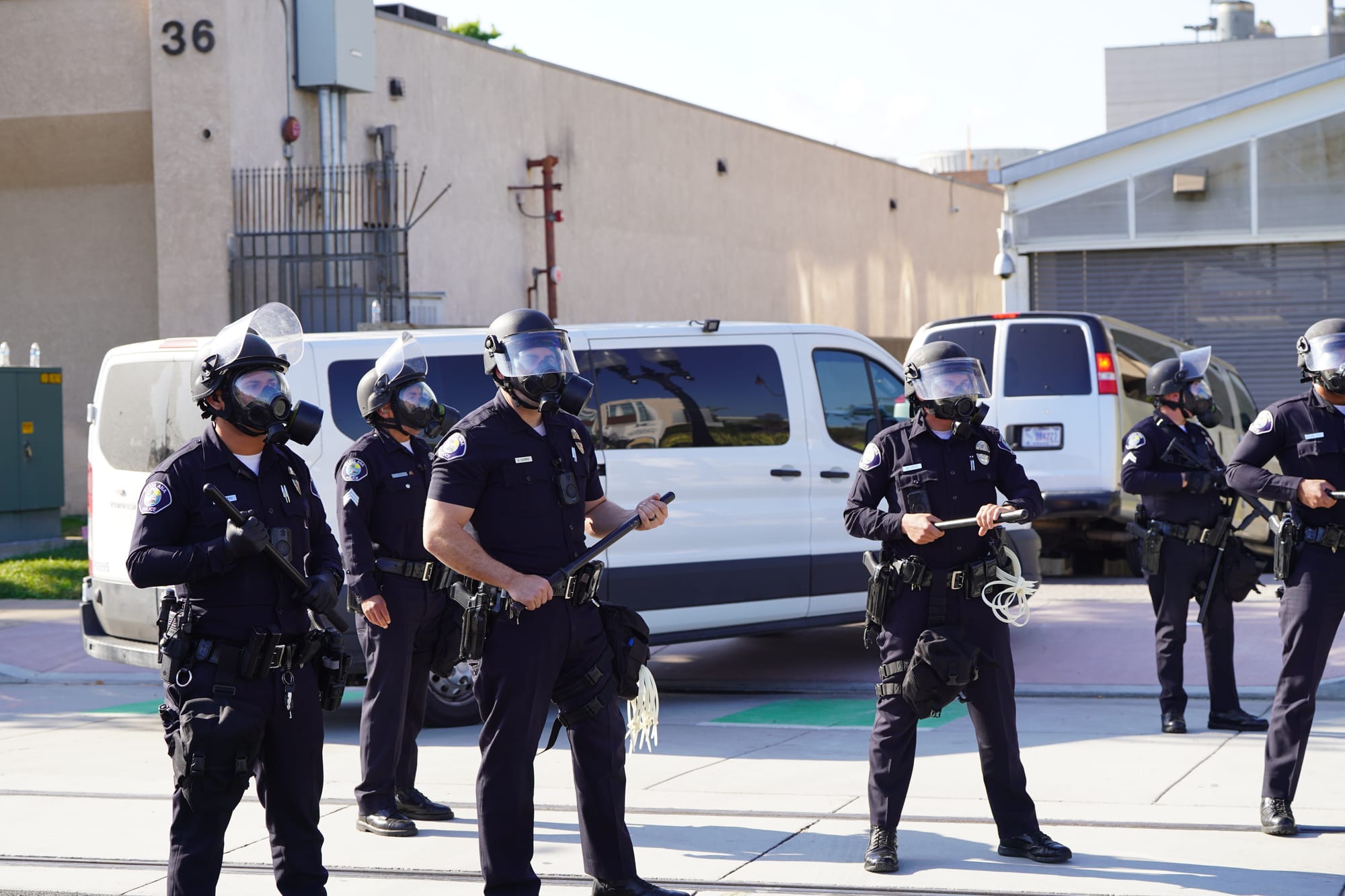
The demonstrations followed federal immigration enforcement activity, including ICE raids, and involved police use of rubber bullets, tear gas, and other crowd-control weapons. Vazquez’s request called for transparency around the total cost of the response, weapons deployed, body-worn camera and surveillance footage, reported injuries, command decisions, and any coordination with outside agencies, including federal authorities—similar to public record requests made by The Santanero last summer and are still pending.
In July 2025, the police department presented its AB 481 military equipment report, outlining summaries of equipment use, including crowd-control tools, but the presentation did not provide a full incident-specific breakdown of the June protests—specifically during a peaceful protest reported live by The Santanero in the early hours of June 12, 2025 on Fourth and Main, where police fired rubber bullets into the crowd without declaring an unlawful assembly.
Council discussing Item 19 of Feb 3, 2026's agenda. (City of Santa Ana YouTube Channel)
The discussion led to a cacophony of responses from the dais, diverse in their efforts to give direction to the City Manager. In Vazquez' ask to have the Police Oversight Commission to hold a hearing, Mayor Valerie Amezcua, Councilmember Jessie Lopez and Councilmember Johnathan Ryan Hernandez wanting to be present at the hearing could raise red flags about Brown Act laws.
In the end, the Council gave direction to the City staff to gather disclosable information on the June 2025 protests within 60 days from Tuesday and later hold a public hearing at a City Council meeting to receive testimonies from protestors affected by actions of the police department during those protests.
How Late Did The Meeting Begin?
The Council was 80 minutes late, achieving a second place rank for tardiness behind their 97 minute mark recorded on August 1, 2024. The average—now reset to begin for this calendar year as of Jan. 20, 2026's meeting—sits at 69 minutes per meeting.
Behavior Chart for Feb. 3, 2026
The Council was reminded by City Attorney Sonia Carvalho about quorum procedures as several members of the dais left without notifying the Chair or Clerk. Some members have left in previous meeting after giving their comments at the end of the meeting without officially declaring their departure for the minutes recorded by the City Clerk. Because of this, the Council as a whole got a yellow card.
In addition, exchanges on the dais between Mayor Valerie Amezcua, Councilmember Johnathan Ryan Hernandez, Councilmember Benjamin Vazquez, Councilmember Phil Bacerra held undertones that could have been more mature in decorum nature. For this, they dropped to the orange tier.
Member
Result
Mayor Valerie Amezcua
🟧
Mayor Pro Tem David Penaloza
🟨
Councilmember Thai Viet Phan
🟨
Councilmember Benjamin Vazquez
🟧
Councilmember Jessie Lopez
🟨
Councilmember Phil Baccera
🟧
Councilmember Johnathan Ryan Hernandez
🟧
SPONSORED
Thank you for being a free subscriber! Consider donating to keep us paywall free!
18 year-old shot, killed by police after short pursuit
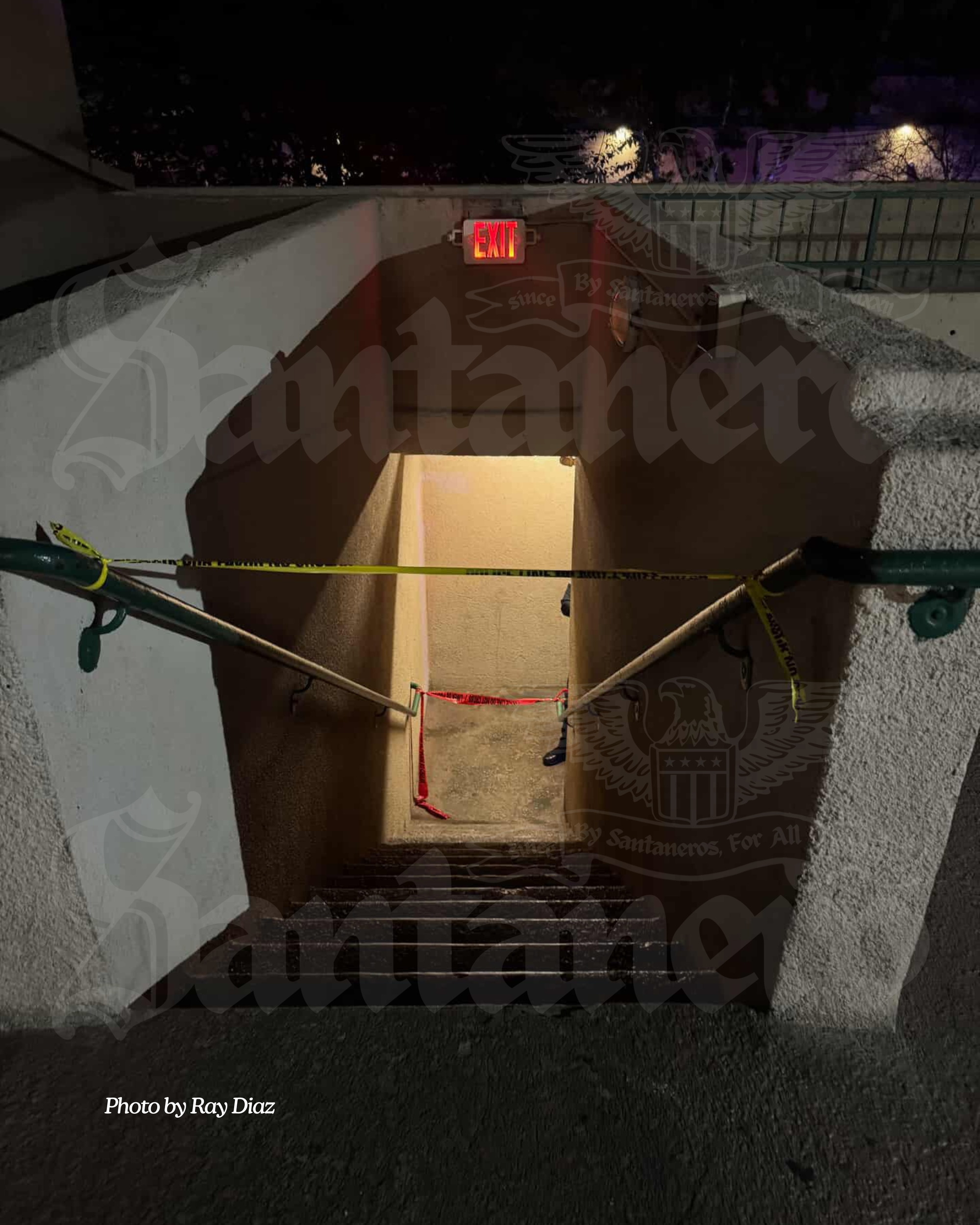
Area of apartment garage taped off. (Ray Diaz)
(THE SANTANERO — Santa Ana, Calif.) Santa Ana Police issued a press release at approximately 4:30 PM Thursday providing additional details about a deadly officer-involved shooting that occurred Wednesday night.
According to the Santa Ana Police Department, the shooting occurred on around 10:29 PM Wednesday, when an officer attempted to stop a vehicle near Santa Ana Boulevard and French Street. In its press release, SAPD stated that the driver “failed to yield to the officer’s attempt to conduct a traffic stop, resulting in a short vehicle pursuit.”
The department’s release does not make clear whether the attempted stop was initiated for an unspecified violation or if the failure to yield was itself the sole reason for the stop. The Santanero contacted Santa Ana Police Department Public Information Officer Natalie Garcia to seek clarification on that point. As of publication, no response had been provided.
According to SAPD, the vehicle ultimately entered the parking garage at 450 E. 4th Street, known as The Spectrum Condominiums. The driver accessed the garage through the Third Street gate near the intersection of Third and French Streets, where the vehicle came to a stop.
The driver, later identified by police as 18-year-old Victor Lopez of Santa Ana, exited the vehicle and dropped a loaded Walther 9mm handgun onto the ground.
According to SAPD, Lopez initially walked toward the officer with his hands raised before turning back toward the firearm and lowering his hands. Police say the officer gave verbal commands instructing Lopez not to reach for “it,” after which an officer-involved shooting occurred.
Video posted by @OCactive_ appears to show Lopez exiting the vehicle with his hands raised and empty-handed before moving back toward the vehicle and bending down. Lopez then moves out of the camera’s view, after which three gunshots can be heard.
According to the press release, Lopez was struck in the upper torso and was pronounced deceased at the scene by the Orange County Fire Authority.
Police said the firearm recovered was loaded and stated Lopez was a suspected gang member and was found in possession of suspected fentanyl in the vehicle.
At the time of the shooting, Lopez’s 19-year-old girlfriend and their one-year-old child were inside the vehicle, according to police.
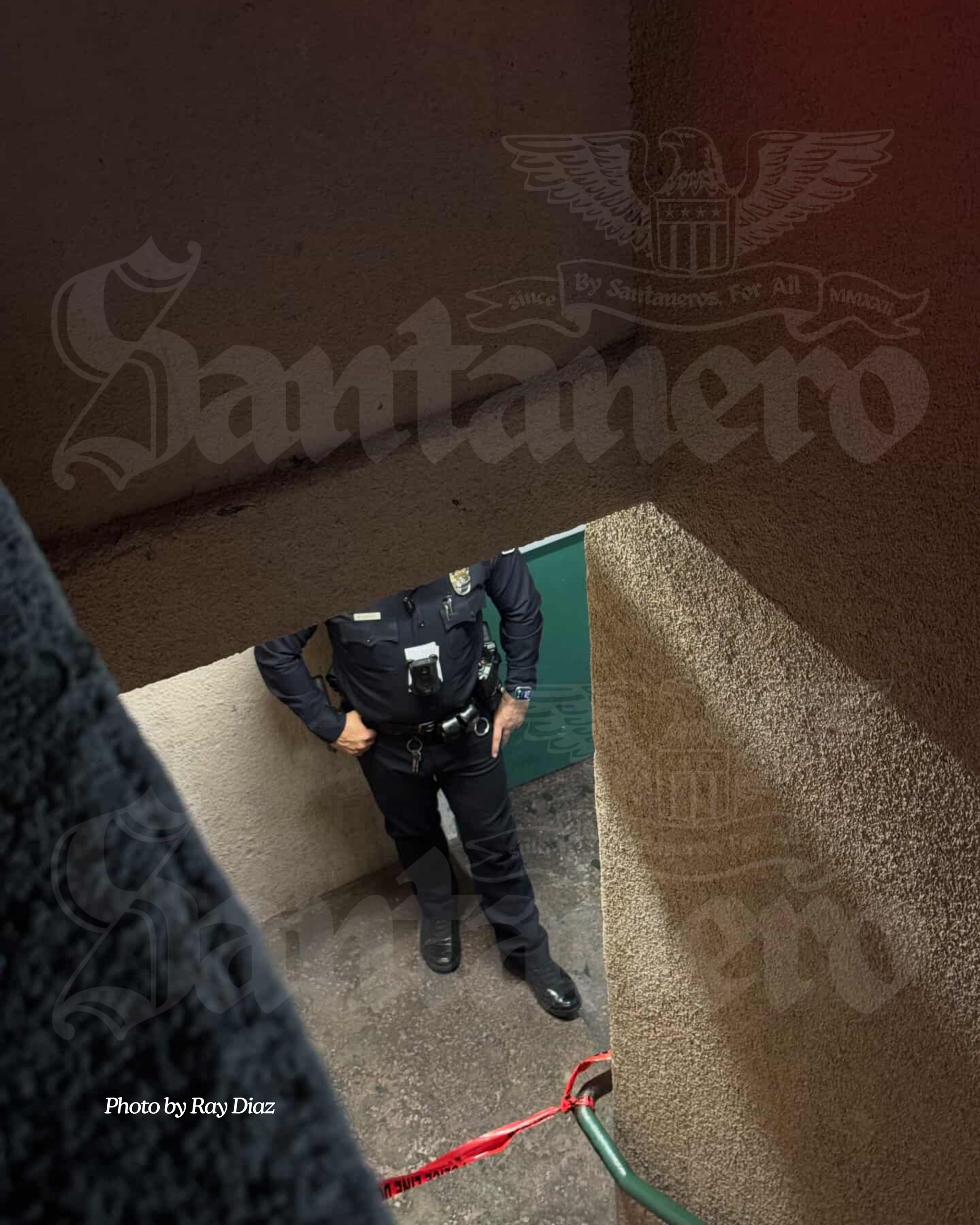
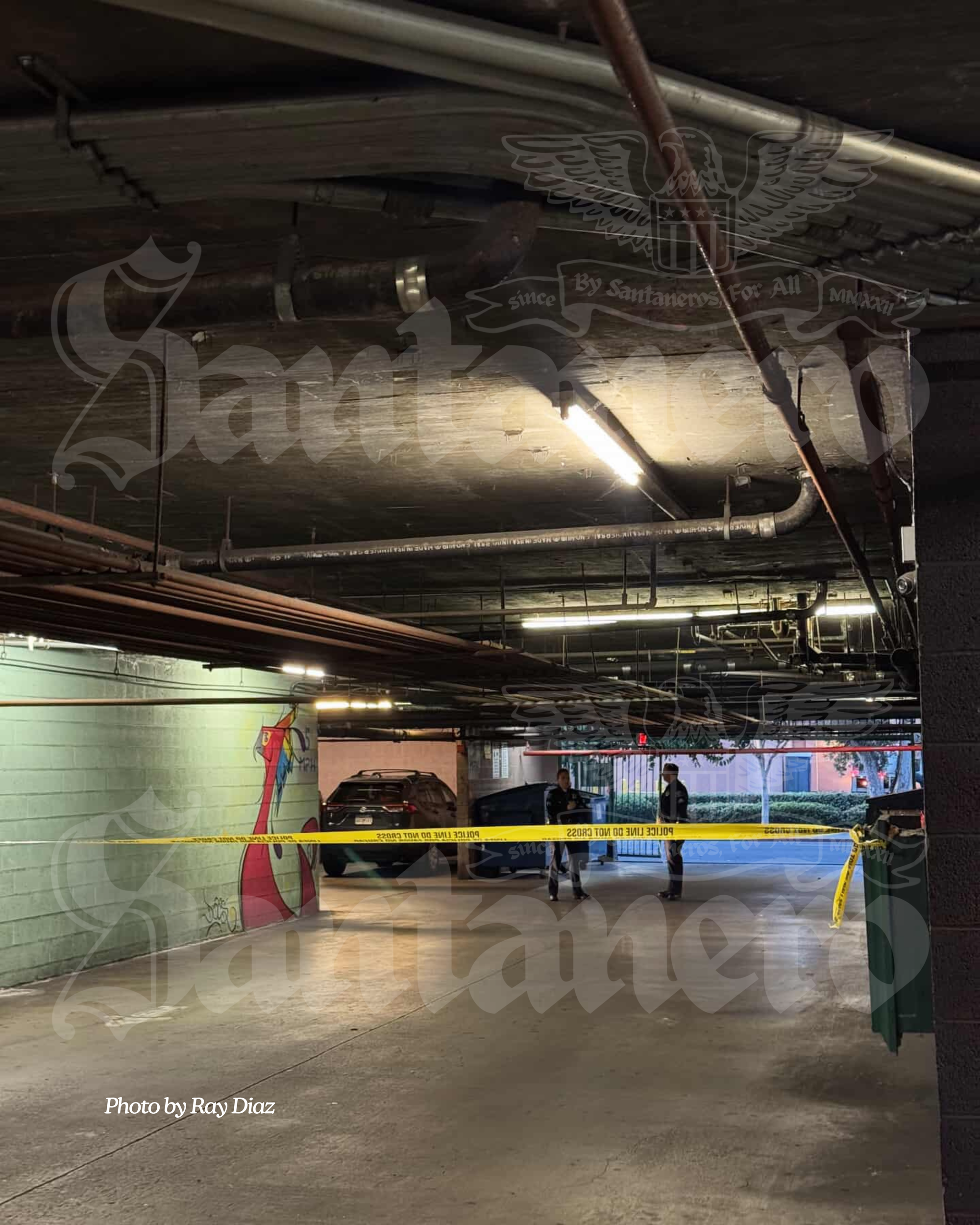
Images from Ray Diaz, resident, showing areas of the apartment garage taped off. (Ray Diaz)
According to Ray Diaz, a resident who lives at the apartment complex, children playing were present inside the parking garage and on upper levels as the incident unfolded.
Photos provided to The Santanero by Diaz show the garage taped off following the shooting for a preliminary investigation.
It remains unclear whether officers ordered residents to leave the garage before or after the shooting, and The Santanero reached out to SAPD for clarifcation.
Neighbors and residents gathered Thursday evening to pay their respects to Lopez.
The officer-involved shooting is being investigated by the Santa Ana Police Department’s Internal Affairs Division and Homicide Unit, along with investigators from the Orange County District Attorney’s Office.
Anyone with information related to the incident is asked to contact the Santa Ana Police Department Homicide Section at (714) 245-8390 or Orange County Crime Stoppers at 1-855-TIP-OCCS.
Bass signed an executive order. Here's why Amezcua can't do that—and what it would take to change it
Amezcua faced public criticism for not demanding the removal of ICE and the National Guard from Santa Ana. However, according to the City Attorney's office, the City Charter does not grant the authority to issue such an order.
A public speaker gives comment before the dais during a city council meeting. (Daniel Diaz/The Santanero)
During the July 1st City Council meeting, public commenters flamed Mayor Valerie Amezcua for not issuing a formal memorandum denouncing the presence of ICE and the National Guard in Santa Ana—similar to Los Angeles Mayor Karen Bass, who recently signed an executive order supporting immigrant communities and condemning ICE raids.
Santa Ana's City Council attempted to establish a relief fund for families impacted by ICE activity, but the effort failed to pass amid disunity amid a brass cacophony of conflicting voices.
In response, City Attorney Sonia Carvalho stepped in, temporarily pausing public comment to clarify the legal constraints of the city's governing document—the City Charter, often referred to as Santa Ana’s version of the Constitution, in which is ruled by the People, not the elected.
City Attorney Sonia Carvalho explaining the difference between LA and Santa Ana during a council meeting on July 1, 2025. (City of Santa Ana YouTube Channel)
"Our credibility is our most important asset in responding to criticism and conflict in our community," said Carvalho. "I can tell you that without a doubt, the Mayor of the City of Santa Ana does not have the power that many of you are saying she has."
Don't worry, If you are lost, we'll help you understand what all this legal jargon means. Scroll!
What are the similarities and differences between Santa Ana and Los Angeles?
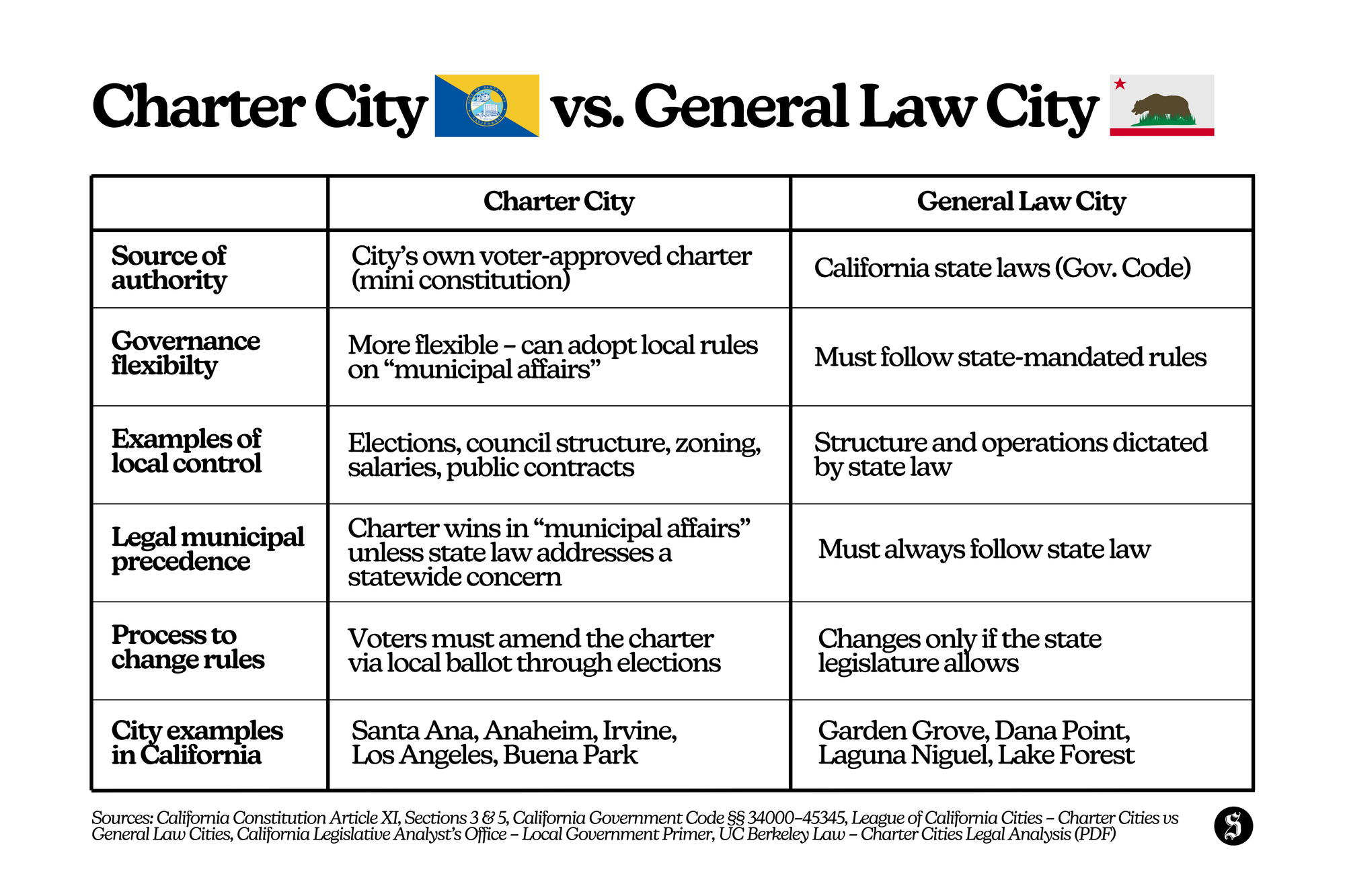
Aside from population, size and vastly diverse districts, Santa Ana and Los Angeles both have charters, Councilmembers, and a Mayor elected by the People. However our systems of governance differ significantly.
Los Angeles operates under a “mayor–council” system, adopted in 1999 by voter approval, which grants their Mayor expanded administrative powers—such as hiring, firing, vetos, and issuing executive directives—even without unanimous support from the City Council or staff.
A perfect example of this was earlier this year where Bass took executive authority to fire former Fire Chief Kristin Crowley amidst the department's response to wildfires across Los Angeles in January.
Amezcua cannot do that, even under public pressure. Why?
Santa Ana, by contrast, follows a “council–manager” model, meaning executive authority lies with the City Manager, not the Mayor. Any official action—such as issuing a memorandum condemning ICE—requires the consensus or direction of the full Council before the City Manager can act on the city's behalf. In this system, the Mayor holds the same voting power as any other Councilmember.
How did L.A. give more power to the Mayor? 🗳️
In the 1990s, Los Angeles faced growing frustration over its fragmented and inefficient city government. Power was spread across elected officials and independent commissions, making accountability murky and action slow. Calls for reform intensified amid rising civic disengagement and even talk of secession from the San Fernando Valley.
To address this, two competing charter reform commissions — one elected by voters, one appointed by the City Council — were formed in 1997. Despite early conflict, the commissions eventually unified their proposals, with support from then-Mayor Richard Riordan, who advocated for a stronger executive branch.
Their efforts culminated in Proposition F, a citywide ballot measure in June 1999, which voters approved by a 60–40 margin. The new charter, effective July 1, 2000, gave the Mayor significantly more power, including the authority to appoint and remove department heads, greater budget control, and a more centralized executive role.
The Council had been in discussions about developing an ICE notification system, but those talks were quickly tempered in June by a (threatening) letter previously sent by U.S. Central District Court Attorney Bill Essayli (the Council voted 5-2 in closed session to suspend further action on the system). The Council instead unanimously approved a resolution on July 1st, requesting help from Congressmember Lou Correa and other federal representatives in pursuing the removal of ICE and the National Guard from Santa Ana, all while filing a Freedom of Information Act request for data regarding immigration arrests.
Carvalho's open door policy
The Santanero accepted Carvalho’s invitation to meet with the community following her brief explanation of the differences between Santa Ana and Los Angeles—and how residents could pursue changes to the City Charter if they wished.
According to disclosures at Tuesday’s city council meeting, only two individuals made such a request, and The Santanero has been the only one who followed through thus far.
So. How can Santaneros change the Charter?
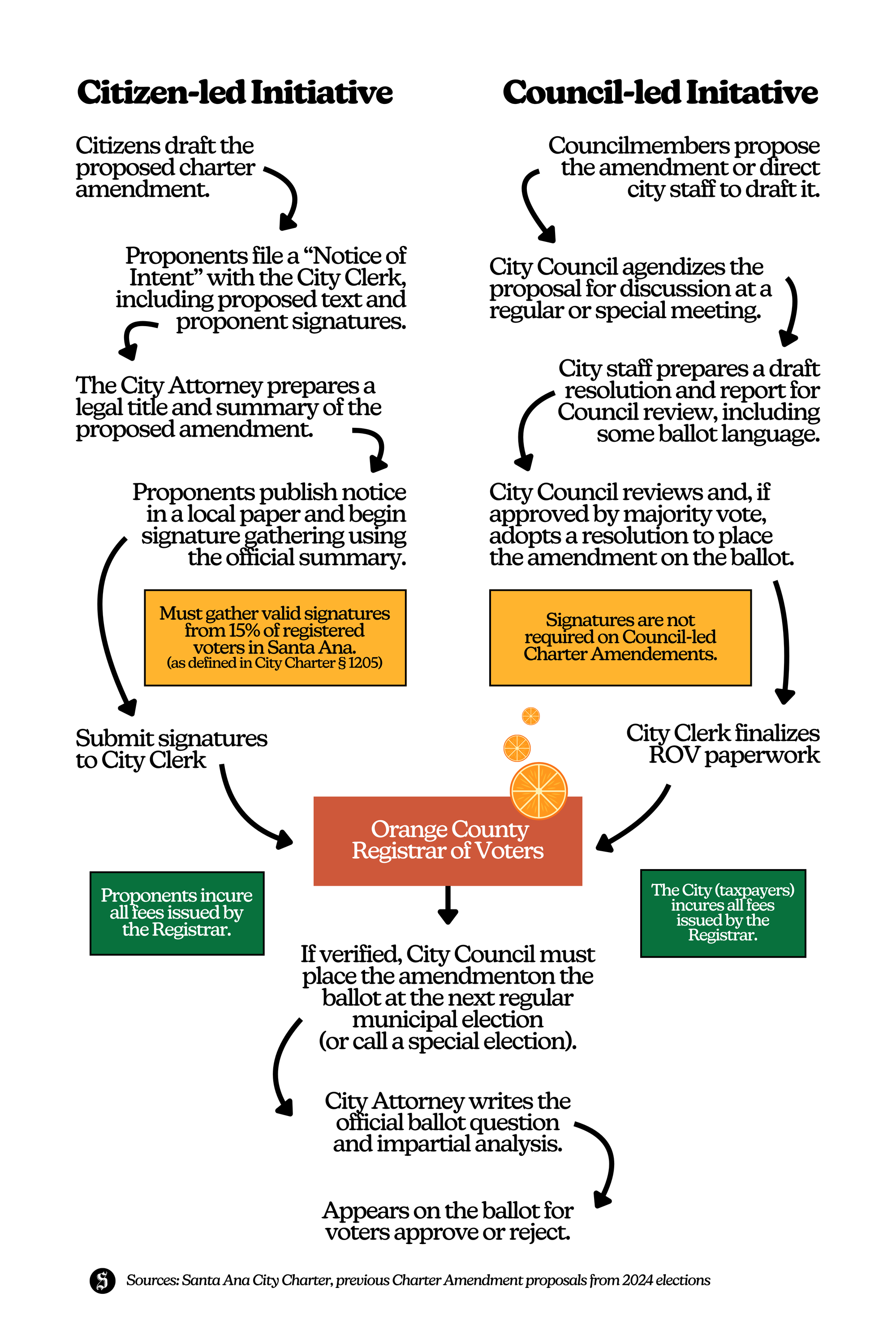
There are two ways to change the Charter: either the People do it or majority vote by the Council. However, they both end up on our ballots to be voted on.
The Santanero was able to verify our graphic with the City Attorney's office, with this added note that there are "exceptions and footnotes" for as each ballot question as each Charter amendment process is different.
Council-led Charter amendment route
Most amendments to the Charter would require legal research by City staff to report back to the Council so that they make an informed decision and isn't always free. Once the Council can come to a consensus, City staff, mainly the City Attorney, will draft an election question to place on the ballot, such as asking voters if they wish to grant the mayor more power or not.
All ballot questions placed on the ballot initiated the City is paid in full by Santa Ana taxpayers, including Council-led charter amendments and special elections.
Citizen-led Charter amendment route
Another way would for the People to come to City Hall to show their "intent to file" by placing a ballot question.
The process would require financial backing and petition signed by the People and once enough signatures have been collected, it is forwarded to the City Clerk and then to Registrar of Voters to be verified. Once checked off, the City Attorney drafts the final way the question will appear before Santanero voters.
The proponent's sponsor or political group would have to come up with the money to pay the ROV's bill to pay the ballot fees, which can cost up to $500,000 per ballot question. Taxpayers do not front the bill for citizen-led charter amendments.
Hypothetically, the ballot question would ask voters whether they want to grant the Mayor—whoever holds the office—greater administrative power, and whether they’re willing to shift the city’s structure from a “council–manager” model to a “mayor–council” form of government.
Below are some notorious Q&A's for educational purposes. This article, including graphics and answers embedded are not legal advice.
What are the consequences of granting more power to a mayor?
Like all consequences, there's good and bad. However, since this is in regard to politics, The Santanero will leave it up to the reader to decide which ones are good and which ones are bad.
Empowering the Mayor could lead to faster action, cohesive strategy, and clearer accountability, and may risk concentrating power, diluting community input, and creating executive-legislative gridlock if not balanced by effective Council oversight. It would also likely cost more taxpayer money.
A change in governance could mean the Mayoral seat having more weight in votes on the dais, setting an unofficial imbalance to other Council seats. Currently, the entire Council and the Mayor sit as equals (one vote each).
It would also hold the Mayor to a figurative pedestal, where the Mayor is the face of the City (while everyone else is just kinda there). If the Mayor underperforms, public criticism would technically carry more weight, as greater authority naturally brings greater accountability.
Santa Ana does not have one face, it has six duly elected and sworn Councilmembers and one Mayor, with those seven working with the City Manager, the City Clerk, and the City Attorney to run the city the way the People want it to be.
Apologies for all the "the's."
Can the Mayor or Council fire an officer?
No, under the Charter, neither the Mayor or any Councilmember can hire, fire, discipline, promote, assign, or direct an officer or any city staff member except for three people: the City Manager, the City Clerk, and City Attorney.
Who can fire an officer?
Santa Ana Police Chief Robert Rodriguez can exercise the right to execute discipline on any officer after a full investigation into the officer's allegations have concluded and been sustained beyond a reasonable doubt (legal speak for they have more than enough evidence to prove the officer did wrong).
If Rodriguez imposes discipline on an officer, it is the officer's right to appeal and could go one of two ways: appeal or lawsuit.
The person above the Police Chief is the City Manager under the form of government the City of Santa Ana has (council-manager). So, only those are technically allow to fire an officer, but officers are allowed to appeal or file a wrongful termination lawsuit against the city if any aspect of the investigation or case was done wrong (which is a conversation for a separate article).
Can the Mayor tell ICE/National Guard to get out of Santa Ana?
The Mayor of Santa Ana, or any elected official for that matter, can personally say “ICE and/or the National Guard should leave” under First Amendment protections, but they cannot officially order it using city letterhead, logos, or in a professional capacity without overstepping the City Charter.
Additionally, legal experts could argue that elected officials are effectively always operating in a professional capacity, even when posting from personal social media accounts—especially since most officials maintain both campaign-related profiles and personal accounts that don’t explicitly reference city business.
Santa Ana’s council-manager system limits the Mayor’s authority to symbolic leadership — actual directives require a majority vote from the City Council and implementation by the City Manager. If the Mayor issues such a command formally, it could be seen as a charter violation or trigger legal and political consequences and even more lawsuits.
This has been a free educational article presented by The Santanero :)